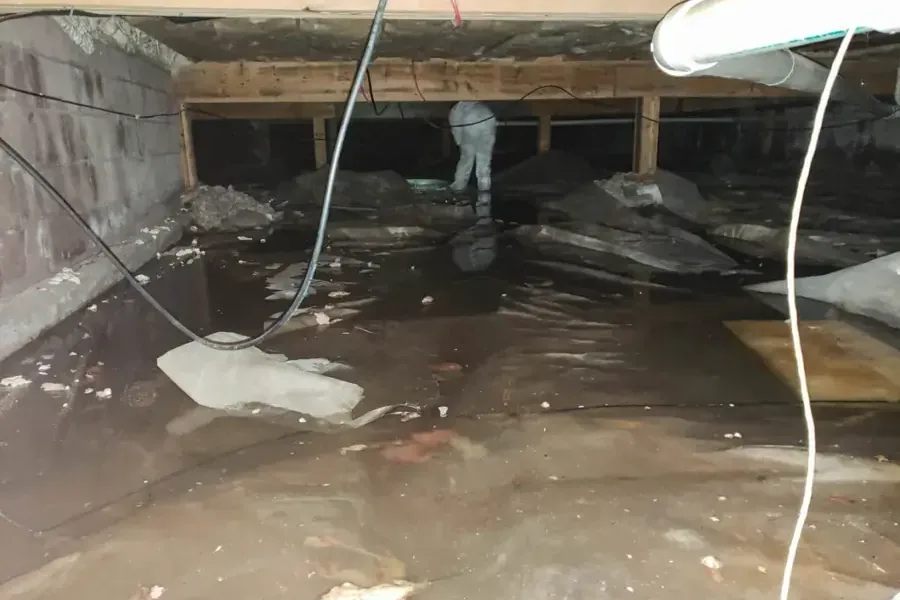
A crawl space can look fine from the yard while water sits on the ground under the floor. In Mableton, where red clay drains slowly, a day of heavy rain is often enough to leave a puddle on the vapor barrier.
Key takeaways
- Standing water on the vapor barrier is a pumping job, while damp air alone is a moisture control problem.
- Red clay drains slowly, so water can sit against a crawl space wall long after the rain stops.
- Wet insulation hanging from the joists is usually removed, because it holds water against the wood.
- A puddle that appears on a dry day points to a plumbing leak or a drain pipe, not the weather.
- Looking into the crawl space from the access door after every heavy storm catches water before it spreads.
Standing water or damp air: how to tell
The two problems look alike from a hallway, but they are handled differently. Standing water is liquid on the ground or the vapor barrier, and damp air is high humidity with no visible puddle.
A flashlight at the access door usually settles the question. Shine it across the floor of the crawl space and look for reflections.
Damp air shows as beads of water on pipes and ducts and a heavy smell, with the ground still firm. That is a ventilation and moisture control issue, and it gets fixed after any real water is gone.
- A shine or ripple on the vapor barrier or on bare soil.
- Muddy streaks on the foundation wall that mark where water entered.
- Insulation batts sagging or lying on the ground.
- Floors that feel cold, bouncy or soft above the wet area.
- Doors and cabinets that stick after a storm.
Why Mableton red clay holds water against a foundation
The soil here is red clay, which is dense and slow to drain. After heavy rain it holds water against foundation walls instead of letting it soak away.
Postwar ranch homes from the 1950s to the 1970s and subdivisions built from the 1980s to the 2000s are often set over crawl spaces. Some of the later ones also have daylight basements.
When the ground around a house is saturated, water follows the lowest path. That path often leads under a foundation wall and into the crawl space.
The climate adds to it. Summer thunderstorms and the remnants of Gulf tropical systems can drop heavy rain on ground that is still wet from the last storm.
Where the water comes from
Finding the source decides whether the water is clean or contaminated, and whether it will come back.
Rain and runoff
Roof runoff that lands at the foundation, a downspout that ends beside the wall and a yard that slopes toward the house all send water to the same place.
- Downspouts that empty right beside the wall.
- Soil that has settled toward the foundation instead of away from it.
- Window wells and vents at ground level that fill during a storm.
Plumbing and drain leaks
A pinhole in a supply pipe or a cracked drain pipe puts water into the crawl space on a dry day. A supply leak adds clean water, but a failed drain pipe adds contaminated water that changes the job.
If the puddle is there when it has not rained for days, shutting off the main water valve shows whether it stops growing.
What to do before the crew starts
Moving water out of a crawl space without equipment rarely works. A bucket cannot outpace seepage, and water left on the soil keeps rising into the floor framing as vapor.
- Stay out of a crawl space with standing water, especially where wiring, ducts or a water heater sit near the floor.
- Turn off power to crawl space lights and outlets at the panel if the panel is dry and the path to it is safe.
- Shut off the main water valve when a pipe is the suspect.
- Photograph the water and the insulation from the access door.
- Do not run a shop vacuum or a fan across standing water.
What the crew removes and dries
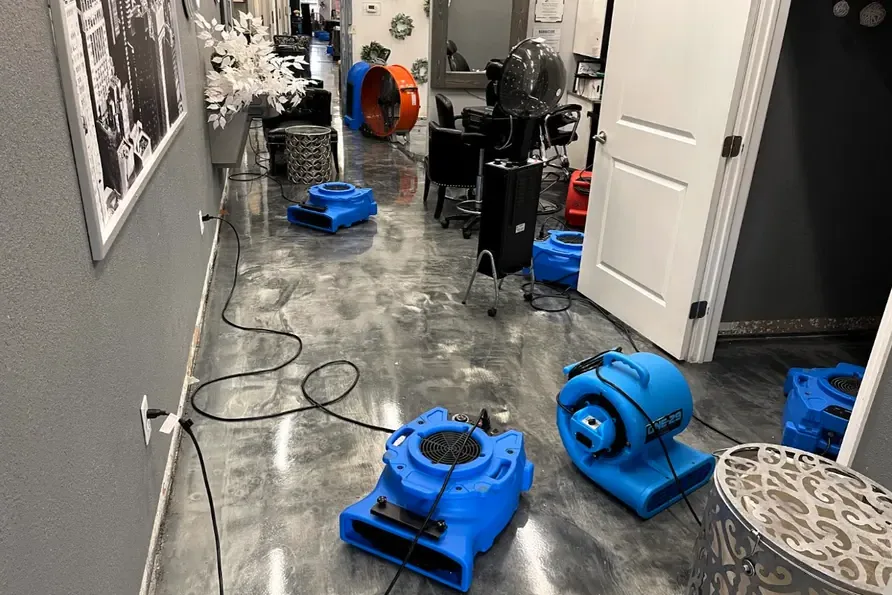
The job starts with a pump-out. A crawl space water removal crew pulls the standing water off the vapor barrier and out of the low spots in the soil, using portable units that fit through the access opening.
Wet insulation comes out next. Fiberglass that has soaked up water loses its value and keeps the joists wet, so it is cut down and hauled away.
The wood is dried, not replaced, unless it has been wet for a long time. Structural drying readings tell the crew when the joists, subfloor and sill area have reached the dry goal.
Water that came from a failed drain pipe is treated as contaminated. The soil surface is cleaned before the barrier goes back.
- Pumping standing water from the barrier and the low corners.
- Removing wet insulation and any torn or soaked sections of vapor barrier.
- Drying joists and the underside of the subfloor with air movers and dehumidifiers.
- Checking moisture readings in the wood until they match a dry reference.
Keeping the next storm out
A few yard fixes lower the odds of a repeat. None of them replaces a pump or a drain, but they reduce how much water reaches the foundation.
- Extend downspouts so they empty well away from the wall.
- Grade the soil so it slopes away from the house.
- Keep gutters clear before the stormy months.
- Clear window wells and vent openings.
- Look into the crawl space from the door after every heavy storm.
Cost and drying time
Cost depends on how deep the water is and whether the insulation has to come out. The crawl space service page prints $1,000 to $2,500 for a clean water pump-out, $2,500 to $4,500 when insulation is removed and $4,000 to $6,500 when a drain pipe or flood water is involved.
The drying time estimator helps a homeowner plan for the days the equipment runs. Heavy wood framing dries slower than a thin subfloor, so the readings decide the final day.
Questions
How can a homeowner tell if a crawl space has standing water?
Open the access door and shine a flashlight across the ground. A shine or ripple on the vapor barrier, wet soil or insulation lying on the ground points to standing water.
Is water under a house covered by insurance?
It depends on the cause. Sudden pipe failures are often covered, while rising ground water or surface water usually needs separate flood coverage, so the policy wording matters.
How long does a crawl space take to dry?
After the pump-out and insulation removal, drying often takes several days. The readings in the joists and subfloor decide when the equipment can come out.
Does a vapor barrier need to be replaced after a flood?
A barrier that is torn, shifted or soaked through is usually replaced, and one that is intact is cleaned and reused. The crew checks it during the pump-out.
Can a crawl space be pumped out without removing insulation?
Only when the insulation stayed above the water. Batts that touched the water usually hold it against the joists, so they are removed.