Water Extraction and Removal in Mableton, GA
Standing water in a Mableton living room, basement or kitchen gets pulled out first. The extraction crew runs truck-mounted and portable units until the carpet, pad and hard floors stop giving up water.
Send the extraction rig to the wet floorOpen 24/7: (888) 532-4616
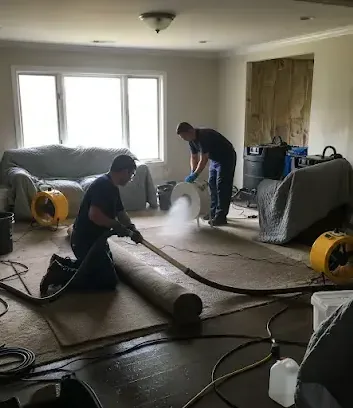
First steps for water extraction and removal in Mableton
Stop the water
Close the main or fixture valve so the extraction crew is not chasing a running leak.
Keep off wet carpet
Walking on soaked carpet pushes water deeper into the pad and the tack strip.
Lift what can move
Raise furniture legs on foil or blocks and pick up rugs, papers and electronics.
Take photos
Shoot every wet room before extraction starts so the claim shows the water at its worst.
What does water extraction and removal cost in Mableton, GA?
Water extraction here typically runs $400 to $1,200 for one room of clean water and up to about $6,000 for a contaminated basement once drying is added. The water category, square footage, material class and how fast drying started move the number most.
Single room, clean water
$400 to $1,200- Carpet and pad extracted
- Hard floor squeegee and wand
- Moisture readings taken
Basement or several rooms
$1,200 to $3,500- Truck-mounted extraction
- Pad removal where needed
- Drying equipment set
Contaminated water
$3,000 to $6,000- Category 3 extraction
- Porous materials removed
- Antimicrobial applied
These are typical ranges, not a quote. The water category, the square footage, the material class and how fast drying started move the number most. The water damage cost calculator gives a planning range.
What a complete water extraction and removal job includes
The order of the work is what separates a finished dry-out from a cosmetic one.
Dispatch around the clock
The response team works 24/7 and sends the nearest available crew with pumps, meters and drying gear on the truck.
Measured to IICRC S500
Moisture mapping comes first, and the equipment stays until readings match a dry reference, not until a room looks dry.
A claim file built daily
Most crews log moisture readings every day and take timestamped photos before anything is cut out, so the file matches the loss.
Built for clay, creeks and crawlspaces
Daylight basements, crawlspaces under postwar ranches and creek-side lots are everyday work for local restoration pros.
Extraction is the step that decides how long everything else takes. Every gallon left in the carpet pad or soaked into a basement slab has to be evaporated later by dehumidifiers, and that costs days. Pulling it out as liquid first is faster and cheaper, which is why the extraction crew starts here before a single air mover is placed.
Where standing water collects in local homes
In ZIP 30126 the water usually pools in the lowest finished space: a daylight basement den, a split-level family room or the hallway outside a laundry closet. Red clay outside the foundation drains slowly, so a basement can hold an inch or more after a long rain while the rooms upstairs stay dry.
- Finished basements with carpet laid over concrete
- Split-level lower floors with laminate or vinyl plank
- Kitchens and laundry rooms on the main floor
- Crawl spaces under older ranch homes
Water still sitting on the floor? The extraction crew pulls it up around the clock.
Book a truck-mounted extractionCarpet, pad and hard floors are handled differently
Carpet over clean water can often be saved: the crew extracts with a weighted wand, lifts the pad where needed and floats the carpet over air movers. Pad soaked by gray or black water comes out. Laminate and engineered plank trap water underneath and are usually lifted so the subfloor or slab can dry. Tile and sealed concrete are squeegeed, extracted and then checked with a meter.
What happens after the water is out
Once the floors stop giving up water, the tech maps moisture in the walls and subfloor with a thermal camera and meters. That map sets the structural drying plan: how many air movers, which LGR dehumidifiers and where to open baseboards. For a basement that keeps taking on water after every storm, see basement flooding cleanup.
Outside references: Ready.gov flood safety and Georgia Office of the Commissioner of Insurance.
How water extraction and removal is handled, start to finish
- 01
Find the source
Confirm the leak is stopped and name the water category.
- 02
Extract
Truck-mounted and portable units pull water from every wet surface.
- 03
Map
A thermal camera and meters show what is still wet.
- 04
Set drying
Air movers and dehumidifiers go where the map says.
Water extraction and removal across Mableton and south Cobb
Coverage runs across ZIP 30126, from the older streets off Floyd Road out along Veterans Memorial Highway and South Gordon Road, down to the homes near Nickajack Creek and the Chattahoochee River side.
Nearby coverage reaches Austell, Smyrna, Vinings, Powder Springs, Lithia Springs, Marietta, Atlanta, Kennesaw.
Water Extraction and Removal questions, answered
How much water can extraction actually remove?
Most of it. A truck-mounted unit pulls far more water per pass than a shop vacuum, and a weighted wand squeezes water out of carpet and pad. What stays behind in drywall, framing and concrete comes out with dehumidifiers during drying.
Can wet carpet be saved after extraction?
Often, if the water was clean and extraction started within a day or two. Carpet that sat in gray water for days, or was touched by sewage or creek water, is removed along with the pad.
Is a wet and dry vacuum enough for a flooded basement?
For a small spill, maybe. For an inch of water across a finished basement, a shop vacuum leaves the pad, the tack strip and the bottom of the drywall soaked. Professional extraction and a moisture map show what a vacuum misses.
How long does water extraction take?
Extraction for a single room is usually finished in one visit. A flooded basement or several rooms take longer, and the drying that follows runs several days with readings logged daily.
Why does the water category matter for extraction?
Category 1 clean water can be extracted and dried in place. Category 2 and 3 water carry contaminants, so porous materials it touched come out and surfaces are treated with an antimicrobial before drying.
Water pooling in the basement or the den?
The longer it sits, the more it wicks into drywall and framing. Extraction comes first, then drying.