Water removal for Kennesaw floors
Standing water on carpet, tile or hardwood starts soaking into the subfloor right away. The extraction crew pumps it out, pulls the wet pad and starts air movers before the damage spreads.
Call for pumps and extractorsOpen 24/7: (888) 532-4616
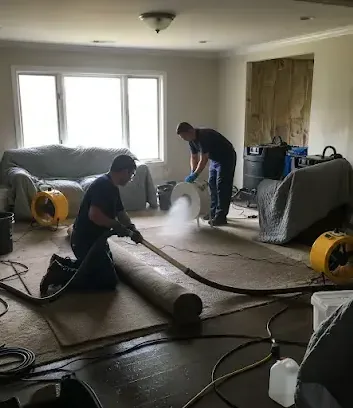
First steps for water extraction and removal in Kennesaw
Stop the source
Close the supply valve if a pipe or hose caused it, and keep people out until outlets are safe.
Lift small items
Move rugs, bags and electronics off wet floors and set furniture on blocks.
Photograph the water
Take wide and close photos of the water, the source and damaged items before moving them.
Call for extraction
Describe the depth, the floor type and whether the water looks clean, so the crew brings the right pumps.
What does water extraction and removal cost in Kennesaw, GA?
Pulling water out of one clean room often costs $400 to $1,200, while a basement or several rooms run $1,200 to $3,500. Contaminated water jumps to $3,000 to $6,000 because the removal and disposal are heavier and protective gear is required.
One clean room
$400 to $1,200- Pump and extractor pass
- Wet pad removed
- Fans set for drying
Basement or several rooms
$1,200 to $3,500- More pumping time
- Baseboards checked
- Extra drying gear
Contaminated water
$3,000 to $6,000- Protective gear used
- Porous items discarded
- Surfaces disinfected
Ranges only, never a quote: the category of water, the wet square footage, the material class and how soon drying began decide the final number. The water damage cost calculator turns your answers into a planning range.
How a water extraction and removal job is run here
Measured drying, steady dispatch and a clean record are what make the job hold up later.
Crews out at any hour
Nights, weekends and holidays, the nearest available crew rolls with extraction units, meters and dehumidifiers.
A dry goal in numbers
Wet materials are read against an unaffected spot in the same building, and the gear stays until the two match.
Records the insurer can follow
Daily readings, a moisture map and dated photos from before any tear-out go into one claim file.
Planned for the building
Older homes, lofts and newer construction dry differently, so equipment is placed to suit the walls and floors in front of the crew.
Local history shows how fast things change. A broken joint on a water pipe opened a sinkhole on Ben King Road in October 2021, and Noonday Creek flooded Chastain Road in September 2009. When water does reach a house, removal has to start before it works into the floor. Extraction is the step that decides whether carpet, pad and flooring can be saved.
How extraction removes water
The crew starts by finding where the water is pooling and where it has already wicked into baseboards and carpet. Submersible pumps clear deeper water, then wand extractors pull moisture out of carpet and pad. Pad that has soaked through is usually cut out and discarded, because it holds water long after the surface feels dry. Hard floors get the same attention, since water slips under planks and tile edges.
Not sure the water counts as an emergency? Describe it to the dispatcher and the crew will say what to do next.
Ask about wet carpetWhat gets checked after pumping
- Subfloor moisture, since plywood and boards drink water slowly
- Wall bases and cabinet kicks where water creeps upward
- Carpet tack strips, pad and floor edges that trap moisture
- Nearby rooms that share a floor or a doorway with the wet area
When the source must be stopped first
Water that is still moving, such as a supply pipe spraying or a drain overflowing, has to be stopped first, because pumping a room that keeps refilling gets nowhere. Once the source is closed the extraction crew can work steadily, and the drying team follows with air movers and dehumidifiers so the structure finishes dry, not just the surface. Storm water that came in from outside is treated as dirty and handled with extra care.
Outside references: Ready.gov flood safety and Georgia Office of the Commissioner of Insurance.
How water extraction and removal is handled, start to finish
- 01
Find the water
Trace pooling and hidden wicking with a meter
- 02
Pump it out
Submersible pumps clear the deeper water first
- 03
Extract the rest
Wand tools lift moisture from carpet and floors
- 04
Start drying
Air movers and dehumidifiers take over
Water extraction and removal across Kennesaw and nearby communities
Crews reach Downtown Kennesaw near Main Street, the Chastain Lakes area and homes across ZIP 30144, with pumps and extractors loaded for jobs from a small spill to a flooded room.
The same service nearby: water extraction and removal in Mableton, Brookhaven, Atlanta.
Water Extraction and Removal questions, answered
Can wet carpet be saved after extraction?
Often yes when the water was clean and extraction began promptly. The crew removes the pad, which rarely dries well, and dries the carpet and subfloor in place or lifts it temporarily to dry.
What if the water is dirty?
Water from a drain, a sewer or outside flooding is treated as contaminated. The crew wears protective gear, removes porous materials and disinfects hard surfaces instead of simply drying them.
Do pumps work if the power is out?
Many pumps run on generator power, so a storm outage does not stop extraction. The crew also keeps people away from standing water near outlets until the electrical risk is clear.
Should I start removing water myself?
A mop, towels and a wet vacuum help with a small spill. Anything deeper than a thin film, or any water from a drain, is better left to the crew, since it can hide in walls and floors.
How does extraction connect to drying?
Extraction removes liquid water, but wood, drywall and concrete still hold moisture afterward. Dehumidifiers and air movers pull that out, and a meter shows when the readings return to normal.
Does storm water need different handling?
Yes. Water that came from a creek, a gutter overflow or the street can carry dirt and bacteria. The crew treats it as contaminated and discards what cannot be cleaned.
Get the water out now
Standing water works into carpet, pad and framing the longer it sits. Call any hour and the extraction crew will plan the pumps.